 ultimate-guide
Commercial Roof Maintenance Tips 2026: 7 Proven Steps
Table of Contents
- Why Commercial Roof Maintenance Matters More in 2026
- Biannual Professional Roof Inspections
- How to Identify Storm Damage on Roof Surfaces
- Your Commercial Roof Inspection Checklist
- Clearing Drainage Systems: Gutters, Scuppers, and Drains
- The Cost of Commercial Roof Repair and Lifecycle Budgeting
- Advanced Diagnostic Tools and 2026 Technology
- Frequently Asked Questions
Last Updated: September 13, 2026
Why Commercial Roof Maintenance Matters More in 2026
Commercial roof maintenance is the practice of inspecting, cleaning, and repairing a building's roof system on a scheduled basis to prevent small problems from becoming structural failures. For property owners and managers, that shift from reactive patching to planned care is now the difference between a roof that lasts and one that drains your budget.
The buildings that fail early are rarely the ones with the worst weather exposure. They're the ones with no maintenance plan. A commercial roof membrane takes a beating from sun, hail, wind, and thermal cycling every single year, and the damage compounds quietly. By the time ponding water or a ceiling stain shows up indoors, you're usually looking at a repair that costs several times what routine upkeep would have.
Below, we'll break down seven proven steps for commercial roof maintenance tips 2026, from inspection schedules to drainage, budgeting, and the diagnostic tools that are changing how problems get caught.
Biannual Professional Roof Inspections
Twice-a-year professional inspections catch the majority of developing problems before they cause interior damage (nrcan.gc.ca). Schedule one in spring and one in fall so your roof is assessed before and after the seasons that stress it most.
A qualified roofing contractor will check the membrane surface, seams, flashing, and penetrations, and look for signs of roof blistering, seam separation, or punctures. Spring inspections reveal winter damage; fall inspections prepare the roof for the cold months ahead.

What to Look for During a Walkthrough
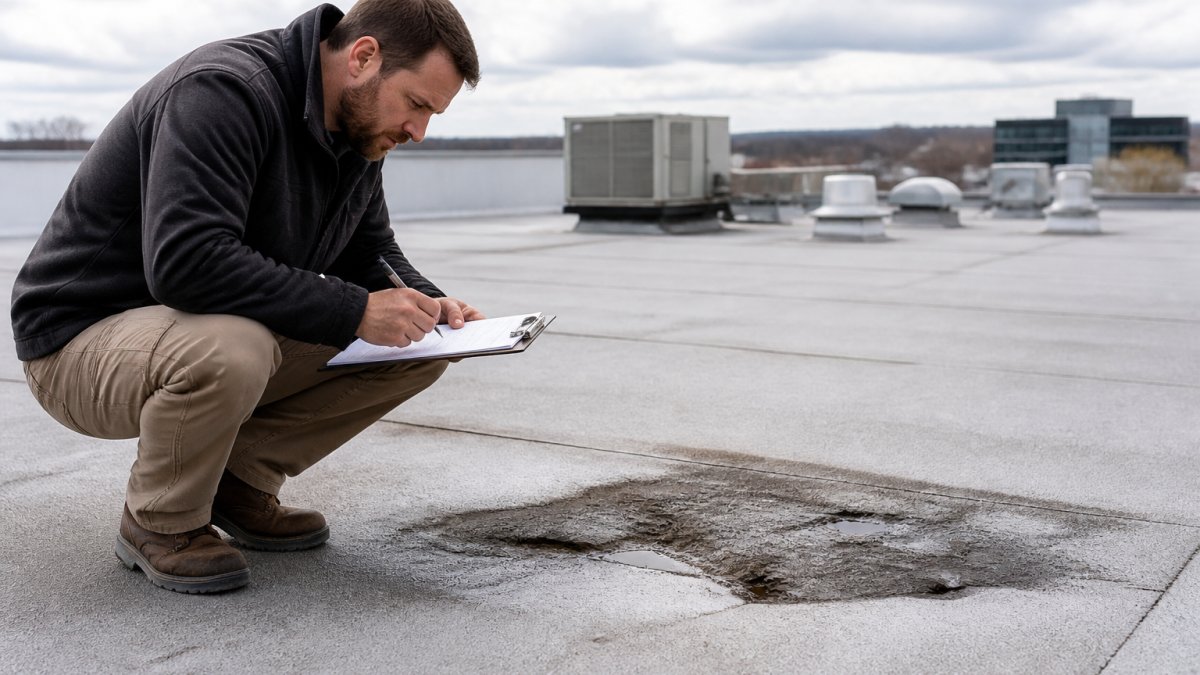
- Ponding water that lingers more than 48 hours after rain
- Cracked or blistered membrane sections near drains and edges
- Loose or lifted flashing around vents, HVAC units, and parapet walls
- Debris blocking scuppers and downspouts
- Rust or corrosion on metal roof substrate and fasteners
Document everything with dated photos. That record becomes your roof maintenance log, and it matters when you file a claim or plan a capital project.
How to Identify Storm Damage on Roof Surfaces
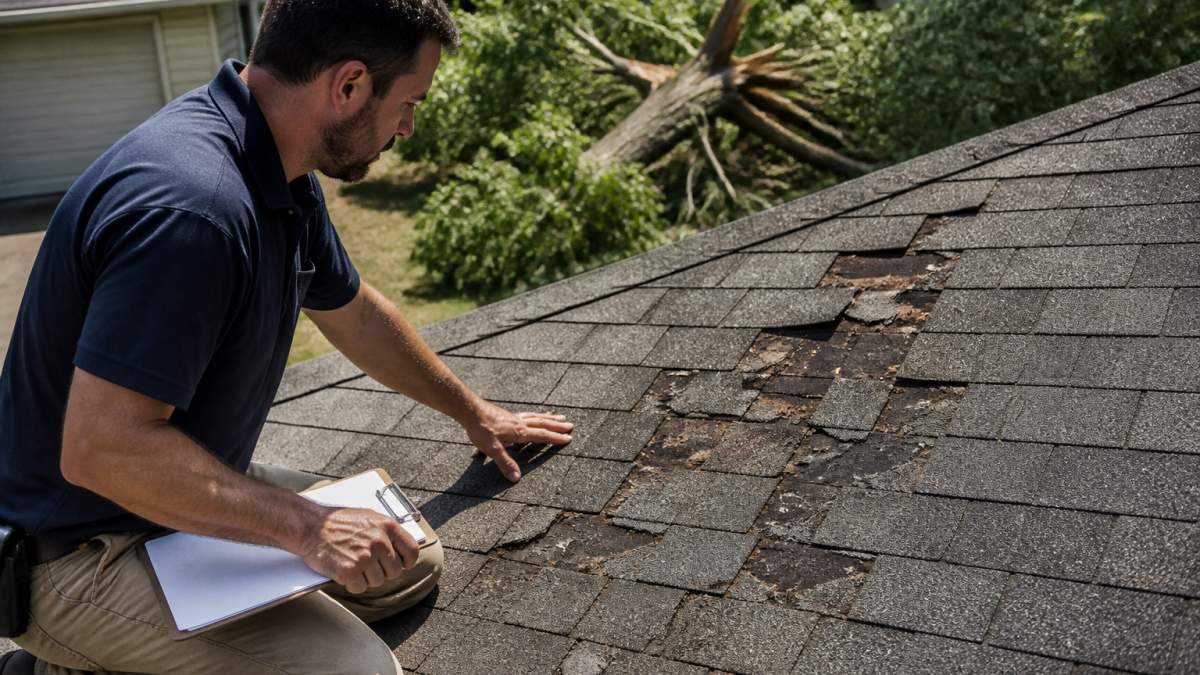
Learning how to identify storm damage on roof starts with knowing what normal wear looks like versus what impact damage looks like. Hail leaves dents and fractures on membrane and metal; high wind tears at edges and lifts seams; heavy rain exposes weak flashing.
Walk the roof only if it's safe and dry. Look for fresh punctures, displaced gravel surfacing, and granule loss on modified bitumen. On metal systems, check for dented panels and loosened fasteners along the windward edge.
Matching Damage Type to Weather Event
The documentation only holds up if the damage pattern matches the event you're claiming. Carriers look for that alignment first.
| Damage Pattern | Typical Cause | What to Photograph |
|---|---|---|
| Circular dents, fractured membrane, bruised shingles | Hail | Dents with a tape measure or coin for scale |
| Lifted seams, torn edge metal, displaced ballast | High wind | Windward edge, seam separation, debris scatter pattern |
| Ponding, saturated insulation, interior staining | Heavy rain or blocked drainage | Water line, drain condition, ceiling stain with date |
| Punctures, crushed insulation board | Falling debris or impact | Object if present, puncture depth, surrounding membrane |
If the pattern doesn't match a single event, the claim is likely to be read as wear-and-tear. That's a documentation problem, not a coverage problem, and it's fixable before you file.
Documenting Damage for Insurance Claims
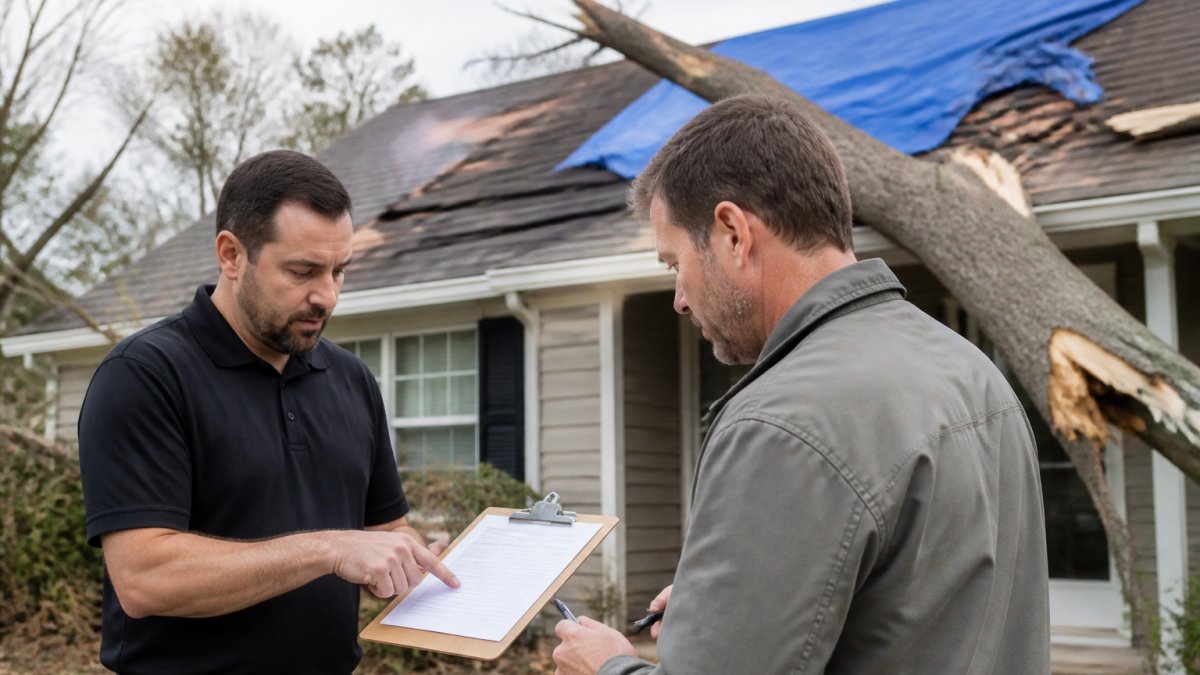
Insurance carriers deny claims when damage looks like deferred maintenance rather than a single event. The fix is a documentation package that shows the roof was in good condition before the loss and that the damage is consistent with the claimed event.
A claim-ready file typically includes:
- Dated photos of the damage with a scale reference (tape measure, coin, or hand) in frame
- Wide shots showing the damage in context on the roof, not just close-ups
- The maintenance log showing the last inspection date, findings, and repairs completed
- The weather event record, date, type, and any local reports of hail size or wind speed
- A written narrative tying the observed damage pattern to that event
- Interior photos if water reached the building, with the date the stain was first noticed
The maintenance log is the piece most owners are missing. Without it, the carrier has no evidence the roof was sound before the storm, and the claim leans toward wear-and-tear findings.
The Pre-Storm Baseline
The strongest insurance position is built before the storm, not after. A biannual inspection with dated photos creates a baseline that proves roof condition at a known point in time. When a claim follows, you're comparing documented condition to documented damage, not arguing from memory.
This is where professional help pays off. Leitch Roofing offers specialized insurance claim assistance, which means we help simplify the process for our clients.
Your Commercial Roof Inspection Checklist
A commercial roof inspection checklist turns a vague walkthrough into a repeatable process. Use the same items every time so nothing gets missed between visits.
| Check | What to Look For | Frequency |
|---|---|---|
| Membrane surface | Blisters, cracks, punctures, granule loss | Biannual |
| Seams and flashing | Separation, lifting, open laps | Biannual |
| Drainage | Ponding water, clogged scuppers, downspouts | Quarterly |
| Penetrations | Loose boots, cracked sealant at HVAC curbs | Biannual |
| Structural integrity | Sagging, soft spots, deck deflection | Annual |
| Interior | Ceiling stains, damp insulation, odors | Monthly |
Clearing Drainage Systems: Gutters, Scuppers, and Drains
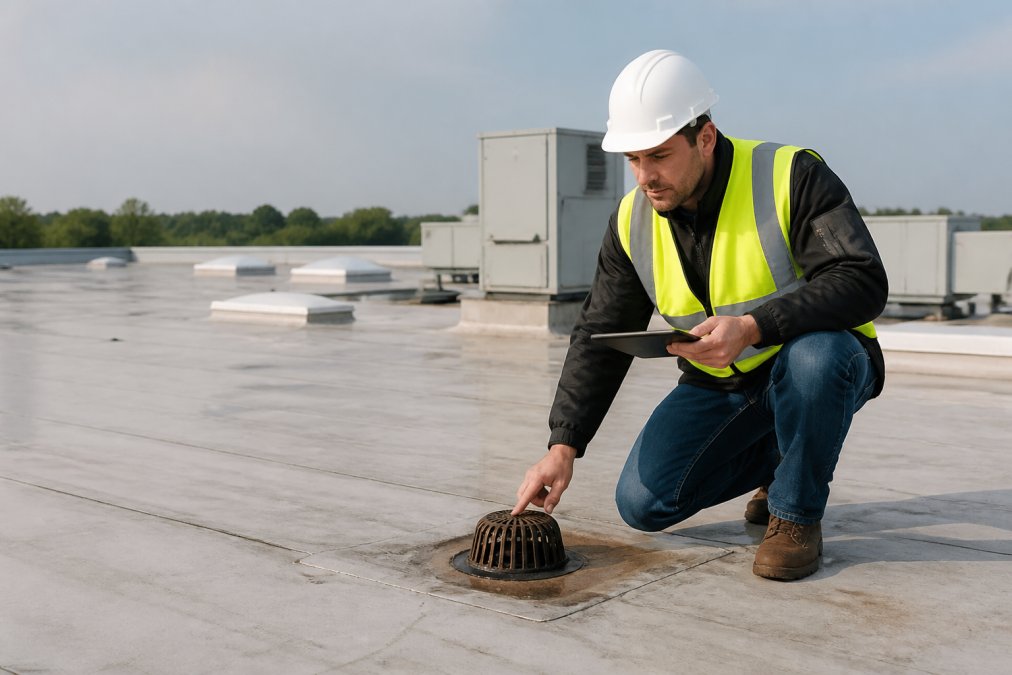
Clogged roof drainage systems cause more preventable commercial roof damage than almost anything else. When water can't exit, it ponds, and ponding water breaks down membrane, adds dead load, and finds every weak seam.
Clear gutters, scuppers, and downspouts at least quarterly, and after any storm that drops leaves or debris (nrcan.gc.ca). On flat roofs, check internal drains for blockages and confirm strainers are intact. Confirm the roof drains slope toward outlets rather than pooling in low spots.
If ponding persists more than two days after rain, the roof has a slope or drainage defect that cleaning alone won't fix (nrcan.gc.ca). That's a structural conversation, not a maintenance task.
The Cost of Commercial Roof Repair and Lifecycle Budgeting
Most commercial roof maintenance guides stop at "budget for repairs." That's not a plan, it's a wish. The useful version treats the roof as a depreciating capital asset with a known service life, a known replacement cost, and a known annual maintenance cost, then funds all three on purpose.
The Lifecycle Cost Formula
Use this framework to compare keeping a roof in service against replacing it:
Annualized Cost of Ownership = (Remaining Maintenance + Repair Spend + Replacement Cost) ÷ Remaining Service Life (years)
Run it twice, once assuming you maintain, once assuming you defer. The deferred scenario almost always shows a higher annualized number because the replacement arrives sooner and the repair spend spikes in the final years.
A worked pattern most property managers recognize:
| Line Item | Maintained Roof | Deferred Roof |
|---|---|---|
| Remaining service life | 12 years | 5 years |
| Planned maintenance (annual) | $0.05-$0.15 per sq ft | $0 |
| Reactive repair spend (cumulative) | Low, spread evenly | High, back-loaded |
| Replacement timing | End of life | Accelerated |
| Annualized cost of ownership | Lower | Higher |
Per-square-foot maintenance figures vary by membrane type, roof age, and climate exposure, so treat any range as a planning input, not a quote. The mechanism matters more than the exact number: spreading predictable spend across a longer service life lowers the annualized cost even when total dollars look similar.
Building the Reserve
A defensible maintenance reserve does three things:
- Sets a per-square-foot annual accrual based on roof area and membrane type, reviewed each budget cycle.
- Separates planned maintenance from capital replacement so a single bad quarter doesn't force a full re-roof decision.
- Tracks actual spend against the accrual so you can see whether the roof is performing to its expected service life or drifting behind it.
If the roof is more than two-thirds through its expected service life and the accrual is underfunded, the honest move is to model replacement now rather than wait for a failure to force the decision on someone else's timeline.
Preventive Maintenance vs. Reactive Repairs
Preventive maintenance is scheduled care that keeps a roof within its expected service life. Reactive repairs are what you pay for after something fails. The two aren't equal in cost.
A preventive maintenance plan spreads predictable spending across the roof's life and extends how long the asset performs. Reactive repairs arrive as emergencies, often at the worst time, and usually cost more because the damage has had time to spread. Roof restoration and roof coating can extend a serviceable roof's life, but only if the substrate is still sound, coating a wet or delaminated deck traps moisture and accelerates the failure it was meant to delay.
Advanced Diagnostic Tools and 2026 Technology
Modern diagnostics find problems the naked eye misses. Moisture testing and thermal imaging detect trapped water inside insulation and roof substrate long before it reaches your ceiling, letting you repair a section instead of replacing a roof.
Drone surveys now let contractors inspect large or steep commercial roofs quickly and safely, capturing high-resolution imagery without sending crews onto every surface. Infrared scans reveal wet insulation as temperature differences, which is far more accurate than spot-checking by hand.
These tools change the economics of maintenance. A thermal scan that flags one wet zone turns a potential full replacement into a targeted repair, and it gives you documented evidence for warranty or insurance discussions. Leitch Roofing uses quality materials and skilled crews on every project, and pairing that work with modern diagnostics can help commercial clients protect the asset for the long run.
Commercial roofs fail on a schedule you can either plan for or get surprised by, and the difference is a maintenance habit rather than luck. Leitch Roofing provides expert residential and commercial roofing services, from biannual inspections and drainage upkeep to full repair and replacement, backed by specialized insurance claim assistance and a free estimate. Get started with Leitch Roofing and protect your building with a roof maintenance plan built around how your property actually performs.
Frequently Asked Questions
How often should a commercial roof be inspected?
Most commercial roofs need a professional inspection twice a year, in spring and fall, plus a check after any major storm. Buildings with heavy rooftop equipment, trees nearby, or a roof older than 15 years may need quarterly visits. A biannual schedule catches small issues like flashing gaps or ponding water before they reach the roof substrate and turn into expensive repairs.
What is the 25% rule in commercial roofing?
The 25% rule is a common insurance and building code guideline in commercial roofing. If storm damage affects more than 25% of a roof's total area, many insurers and local codes require full replacement rather than a patch repair. This matters because a partial repair on a heavily damaged roof can leave you with mismatched sections and future warranty problems.
How does a preventive maintenance plan save money on insurance claims?
A written preventive maintenance plan with dated inspection logs and repair records shows your insurer that the roof was actively cared for. That documentation supports roof warranty compliance and strengthens claims after weather-related damage. Insurers are more likely to approve a claim when you can prove the damage came from a storm, not from neglect like clogged drains or ignored ponding water.
What should be included in a commercial roof inspection checklist?
A solid checklist covers the roof membrane, flashing, seam separation, roof penetrations, drainage systems (scuppers, gutters, downspouts), and signs of ponding water or blistering. Add moisture testing and thermal imaging for a deeper look. Note the roof substrate condition, any debris buildup, and the date of each inspection so your maintenance log stays current.