 listicle
5 Best Commercial Roofing Materials for Hot Climates
Table of Contents
- Why Material Choice Matters in Hot Climates
- Quick Comparison Table
- 1. TPO Membrane: Energy Efficiency and Cost Balance
- 2. Standing Seam Metal Roofing: Durability and Heat Dissipation
- 3. PVC Membrane: Chemical Resistance and Reflectivity
- 4. Spray Polyurethane Foam: Superior Insulation for Complex Roofs
- 5. Clay and Concrete Tile: Thermal Mass and Long-Term Value
- Commercial Roof Energy Efficiency Standards and Cool Roof Certification
- Frequently Asked Questions
Last Updated: September 23, 2026
Why Material Choice Matters in Hot Climates
Selecting the 5 best commercial roofing materials for hot climates isn't just about aesthetics, it directly impacts your building's energy costs, structural longevity, and insurance liability. In regions with intense solar radiation and sustained high temperatures, the wrong material choice can cost your business thousands annually in excess cooling expenses while accelerating degradation that leads to premature replacement.
The difference between a reflective membrane and conventional asphalt can shift your HVAC load by 15-20%, which compounds over decades of operation.
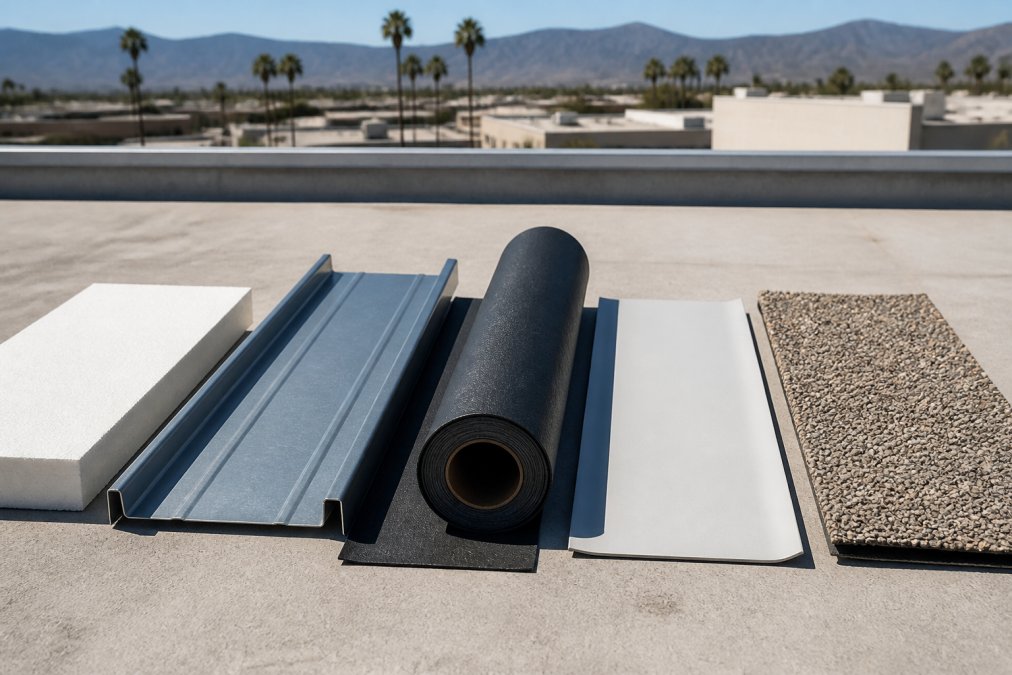
The 5 best commercial roofing materials for hot climates each address heat management differently, some through reflectivity, others through thermal mass or superior insulation. Understanding these distinctions helps you match material performance to your building's specific use case, structural capacity, and financial constraints.
Quick Comparison Table
| Material | Key Strength | Best Application | Primary Consideration |
|---|---|---|---|
| TPO Membrane | Energy efficiency + cost balance | Flat commercial roofs, warehouses | Seam durability in extreme heat |
| Standing Seam Metal | Durability and heat dissipation | Long-term installations, high-wind zones | Higher upfront investment |
| PVC Membrane | Chemical resistance + reflectivity | Industrial, food service, chemical facilities | Premium pricing vs. TPO |
| Spray Polyurethane Foam | Superior insulation, seamless coverage | Complex roof geometries, retrofits | Professional installation critical |
| Clay and Concrete Tile | Thermal mass, aesthetic appeal | Sloped roofs, architectural buildings | Structural reinforcement required |
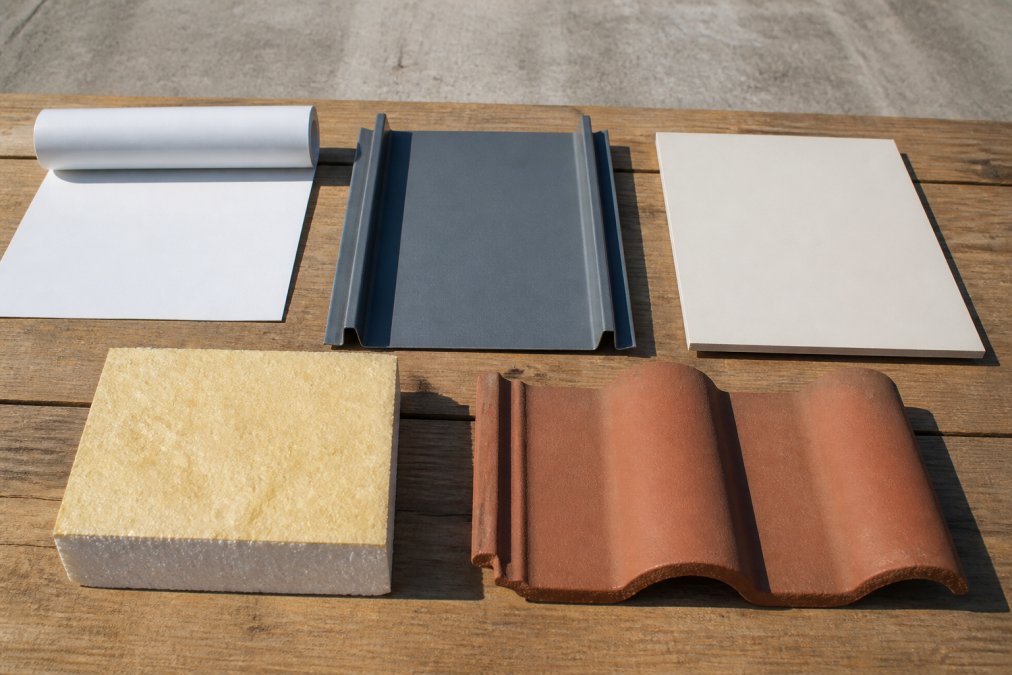
1. TPO Membrane: Energy Efficiency and Cost Balance
TPO (Thermoplastic Polyolefin) membrane is the most widely specified single-ply roofing system in hot climates because it delivers strong energy performance without premium pricing. Its white color provides high solar reflectance, reducing heat absorption into the building structure.
Heat-welded seams create strong, watertight joints resistant to moisture infiltration. TPO resists mold, dirt, and chemical buildup, extending cleaning intervals and reducing maintenance costs.
TPO's weakness: seams are the failure point if installation quality drops. Improperly welded seams can develop leaks years after installation, making contractor selection as critical as material choice.
TPO works best for large flat or low-slope roofs. Complex roof geometry or numerous penetrations increase seam count and installation risk proportionally.
Pros:
- Excellent solar reflectance reduces cooling costs
- Cost-effective compared to PVC or metal systems
- Lightweight, suitable for most roof decks
- Resistant to mold, dirt, and chemical exposure
Cons:
- Seams are vulnerable to improper installation
- Thermal expansion can stress seams in extreme heat cycles
- Lower puncture resistance than PVC or metal
2. Standing Seam Metal Roofing: Durability and Heat Dissipation
Standing seam metal roofing, typically aluminum or steel with protective coating, offers the longest lifespan of any commercial roofing system, many installations exceed 40 years with minimal maintenance, fundamentally changing the financial calculus of roof replacement.
Raised seams interlock mechanically, eliminating seam-failure risk. Metal's high thermal conductivity dissipates heat rapidly, reducing heat transfer into the building interior, especially effective in climates with intense midday solar gain.
Metal roofing offers inherent fire and wind resistance, which can lower insurance premiums in high-risk zones, and resists UV degradation that breaks down organic membranes.
Metal roofing typically costs 30-50% more than TPO upfront, but over 30+ years of operation, the per-year cost becomes competitive with membrane replacement cycles.
Metal roofing requires specialized crews and fastening systems, with thermal expansion and contraction demanding precision in fastener placement.
Pros:
- Exceptional longevity, often 40+ years
- Superior heat dissipation properties
- High wind and fire resistance
- Minimal maintenance requirements
Cons:
- Higher initial investment than membranes
- Requires specialized installation expertise
- Noise during heavy rain (addressable with underlayment)
3. PVC Membrane: Chemical Resistance and Reflectivity
PVC (Polyvinyl Chloride) membrane is the premium single-ply option for facilities with chemical exposure, food processing plants, industrial manufacturing, restaurants with grease-laden exhaust. It resists oils, grease, solvents, and compounds that degrade TPO.
PVC's reflectivity matches TPO for solar heat reduction. Heat-welded seams deliver 20-30 year lifespans in hot climates. The material is puncture- and impact-resistant, important for facilities with rooftop equipment or foot traffic.
PVC typically costs 15-25% more than TPO, making it harder to justify unless chemical resistance addresses a facility-specific risk. For general commercial applications, TPO delivers similar energy performance at lower cost.
PVC performs well on both flat and sloped roofs, though installation remains critical. The seams must be properly welded to realize the material's durability advantage.
Pros:
- Superior chemical resistance for industrial use
- High solar reflectance for energy efficiency
- Durable, impact-resistant membrane
- Strong heat-welded seams
Cons:
- More expensive than TPO
- Premium pricing not justified for non-chemical applications
- Seam quality still depends on installer skill
4. Spray Polyurethane Foam: Superior Insulation for Complex Roofs
Spray Polyurethane Foam (SPF) applies as a liquid that expands into a seamless insulating layer, eliminating seams, the single largest failure point in roofing systems. SPF delivers the highest R-value per inch of any roofing insulation (R-6.0 to R-7.0), making it ideal for retrofits or adding insulation without structural reinforcement (FAQs).
Seamless application adapts to complex geometries and penetrations without extensive seaming. Self-flashing seals penetrations during spray application. It can be applied over existing roofs without removal, reducing installation time and debris costs.
Ventilation Requirements and Heat Management:
In hot climates, proper roof cavity ventilation is essential to prevent heat and moisture accumulation that degrades foam and shortens system life. SPF applied without adequate ventilation traps moisture, leading to mold growth, wood rot, and foam degradation.
Best practice in hot climates: (1) Install ventilation channels between the roof deck and SPF layer to remove moisture and heat buildup, extending system life; (2) Use closed-cell foam (1.5-2.0 inches) as a vapor barrier, preventing moisture migration; or (3) Apply SPF over existing ventilated roofs without removing the membrane.
Inadequate ventilation is a common cause of SPF failure.
Installation Quality and Defect Risk:
Topcoat Maintenance:
Best Applications for SPF:
Pros:
- Superior insulation value, highest R-value per inch
- Seamless application eliminates seam failure risk
- Adapts to complex roof shapes and penetrations
- Can be applied over existing roofs without removal
- Self-flashing around penetrations reduces labor
Cons:
- Requires experienced SPF contractors and third-party inspection
- Topcoat maintenance is essential for UV protection and system longevity
- Ventilation requirements add complexity and cost in hot climates
- Installation defects are difficult to detect and costly to remediate
- Higher material and labor costs than membranes
- Long-term performance depends heavily on topcoat maintenance discipline
5. Clay and Concrete Tile: Thermal Mass and Long-Term Value
Clay and concrete tile's thermal mass absorbs solar energy during the day and releases it slowly at night, moderating interior temperature swings and reducing peak HVAC demand.
Pros:
- Exceptional thermal mass properties reduce peak cooling loads
- Extreme durability, 50+ year lifespan
- Non-combustible, fire-resistant material
- Aesthetic appeal for architectural buildings
Cons:
- Heavy weight requires structural reinforcement
- Labor-intensive installation
- Retrofit applications often infeasible
- Higher material and installation costs
Commercial Roof Energy Efficiency Standards and Cool Roof Certification
CRRC certification is based on two key metrics:
Solar Reflectance (SR): The percentage of solar radiation reflected away from the roof surface, measured on a scale of 0 to 1.0. A reflectance of 0.65 means 65% of incoming solar energy is reflected; the remaining 35% is absorbed. In hot climates, materials with SR values above 0.65 are considered "cool roofs."
Material Performance Under CRRC Standards:
Energy Savings Impact:
Frequently Asked Questions
What is the best roofing material for hot climates?
The best choice depends on your building's structure and priorities. TPO and PVC membranes excel at solar reflectance and lower cooling costs immediately. Standing seam metal roofing offers unmatched durability and heat dissipation over 40+ years. Clay and concrete tile provide exceptional thermal mass to slow heat absorption. For complex roof geometries, spray polyurethane foam delivers superior insulation. Most commercial buildings in hot climates benefit from materials with high solar reflectance (albedo) ratings and low thermal emittance to minimize heat island effect.
How do cool roof coatings improve energy efficiency in commercial buildings?
Cool roofs use reflective coatings and light-colored membranes to bounce solar radiation away rather than absorbing it. Materials like TPO and PVC achieve solar reflectance ratings of 0.65 to 0.85, meaning 65-85% of sunlight is reflected. This directly reduces the heat load on your HVAC system, lowering cooling costs by 10-30% depending on climate and building insulation. Cool roof certification through the Cool Roof Rating Council (CRRC) validates these reflectance and thermal emittance values, helping you qualify for energy rebates and meet commercial roof energy efficiency standards.
How long do reflective commercial roofing materials typically last?
TPO and PVC membranes typically last 15-20 years with proper maintenance and UV protection. Standing seam metal roofing often exceeds 40-50 years and resists UV degradation far better than single-ply membranes. Spray polyurethane foam systems last 20-30 years but require periodic recoating to maintain reflectivity. Clay and concrete tile can last 50+ years due to their inherent resistance to UV radiation and weather. Longevity depends on installation quality, roof ventilation, maintenance frequency, and climate severity. Professional installation and regular inspections extend the lifecycle of any material.
Does roof color significantly impact cooling costs for commercial properties?
Yes. Roof color directly affects solar reflectance (albedo). A light-colored TPO or PVC roof with high albedo reflects more sunlight and reduces surface temperature by 50-60°F compared to dark asphalt. This lower surface temperature means less heat transfer through the roof assembly, reducing HVAC load and cooling costs. Metal roofing with reflective coatings achieves similar benefits. In hot climates, switching from dark to reflective roofing can reduce annual cooling energy use by 10-30%, offsetting higher material costs within 5-10 years through energy savings alone.
What should I know about commercial roof replacement cost guide considerations?
Commercial roof replacement costs vary by material, roof size, slope, and structural requirements. TPO membranes are typically the most affordable option per square foot. PVC costs 10-20% more but offers superior durability. Standing seam metal roofing requires higher upfront investment but delivers 40+ year lifespan, improving lifecycle cost. Clay and concrete tile demands structural reinforcement, increasing labor costs significantly. Spray polyurethane foam suits complex geometries but requires certified applicators. Request quotes from qualified contractors and factor in energy savings, warranty coverage, and maintenance frequency over the roof's expected lifespan, not just installation price.