 how-to
How to Inspect Commercial Flat Roofing Systems
Table of Contents
- Why Regular Commercial Flat Roof Inspections Matter
- When to Schedule Your Commercial Roof Inspection
- Safety Precautions and Inspection Preparation
- Step-by-Step Roof-Walk Inspection Sequence
- Commercial Roof Inspection Checklist by Material Type
- Flat Roof Membrane Inspection: Identifying Common Defects
- Commercial Roof Drainage Inspection: Checking Gutters and Drains
- Creating Your Commercial Roof Inspection Report
- Frequently Asked Questions
Last Updated: October 19, 2026
Why Regular Commercial Flat Roof Inspections Matter
Learning how to inspect commercial flat roofing systems is a systematic walkthrough to identify damage, deterioration, and maintenance needs before they become costly problems.
Most commercial property owners don't inspect their roofs until something leaks.
Your roof faces constant sun, rain, wind, and temperature swings that degrade membranes, seams, and drainage systems.
Knowing your roof's actual condition gives you control over repair timing and budgets.
When to Schedule Your Commercial Roof Inspection
Seasonal timing and frequency
Commercial flat roofs need inspection at least twice per year: once in spring and once in fall. Spring inspections catch winter damage from snow load, ice dams, and freeze-thaw cycles. Fall inspections prepare your roof for heavy rain and winter weather ahead.
Each season brings different stresses:
- Spring: Check for ice dam damage, membrane separation from freeze-thaw, and debris accumulation from winter
- Summer: Inspect for blistering from heat and UV exposure, and verify drainage after heavy rains
- Fall: Document condition before winter weather arrives, clear debris from drains and gutters
Beyond seasonal timing, inspect your roof after any significant weather event. Heavy rains, hail, high winds, and temperature extremes can cause immediate damage that spreads if left unchecked.
Post-storm inspection triggers
Storm damage doesn't always show up immediately. Wind can loosen seams without tearing them visibly. Hail creates small punctures that leak weeks later. Heavy rain exposes drainage failures you didn't know existed.
Schedule an inspection within 48 hours of:
- Hail storms (any size hail)
- High winds above 40 mph
- Heavy rain with standing water
Post-storm inspections identify urgent repairs and document damage for insurance claims. Photos taken within 48 hours of a storm are far more credible to adjusters than photos taken weeks later.
Safety Precautions and Inspection Preparation
Never inspect a roof alone. Always have a second person present in case of falls or injuries.
Use proper fall protection if your roof height exceeds 6 feet. Many commercial flat roofs are low-slope, making them seem safer than they are.
Prepare before you climb:
- Check weather conditions, avoid inspecting during rain, high winds, or extreme heat
- Wear long pants and a long-sleeved shirt to protect skin from sharp edges and sun exposure
- Bring a flashlight for checking dark areas and penetrations
Know your building's roof layout before you start.
If your roof is steep, has structural damage, or exceeds your comfort level, hire a professional.
Step-by-Step Roof-Walk Inspection Sequence
When learning how to inspect commercial flat roofing systems, start from one corner of the roof and work systematically across the entire surface. Systematic coverage ensures you won't miss problem spots.
Inspecting the roof membrane and surface
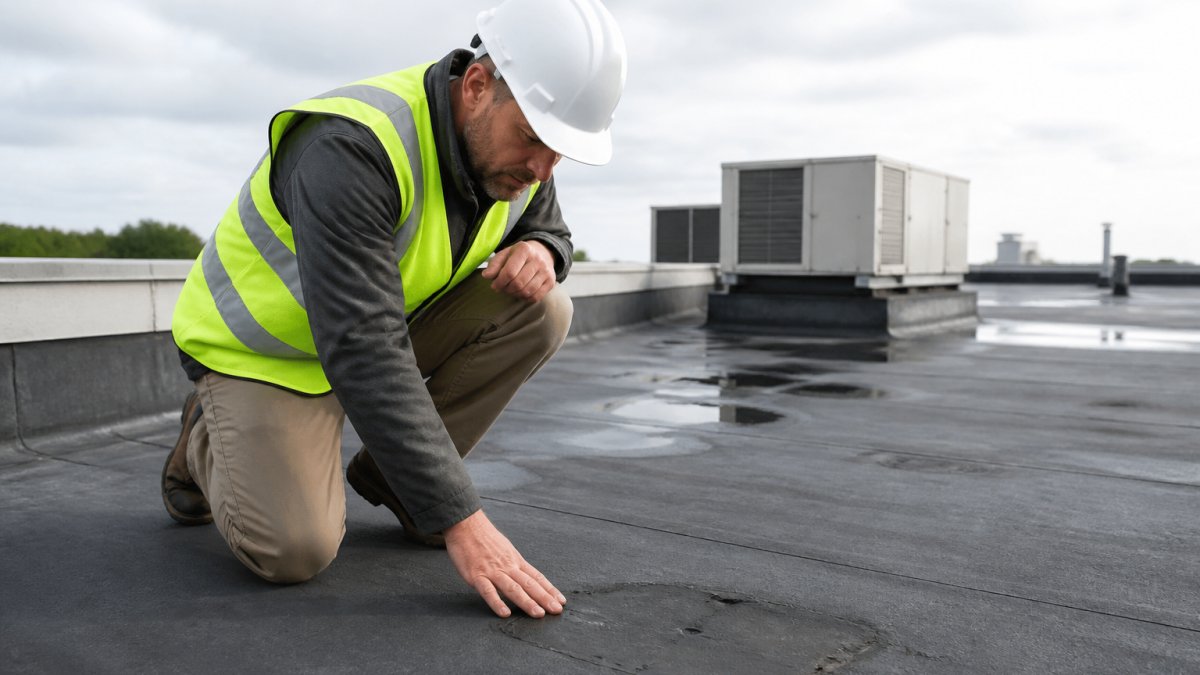
The roof membrane is the waterproof layer that protects everything below. Walk the entire roof surface slowly, examining every section for visible damage.
Look for:
- Cracks, punctures, or tears in the membrane
- Blisters or bubbles that indicate trapped moisture
- Soft spots where the membrane feels spongy or weak
Press down with your hand to check firmness; the membrane should feel solid, not soft or squishy.
Photograph any defects you find, including a reference object (a ruler, coin, or your hand) so the damage scale is clear.
Checking seams, flashing, and penetrations
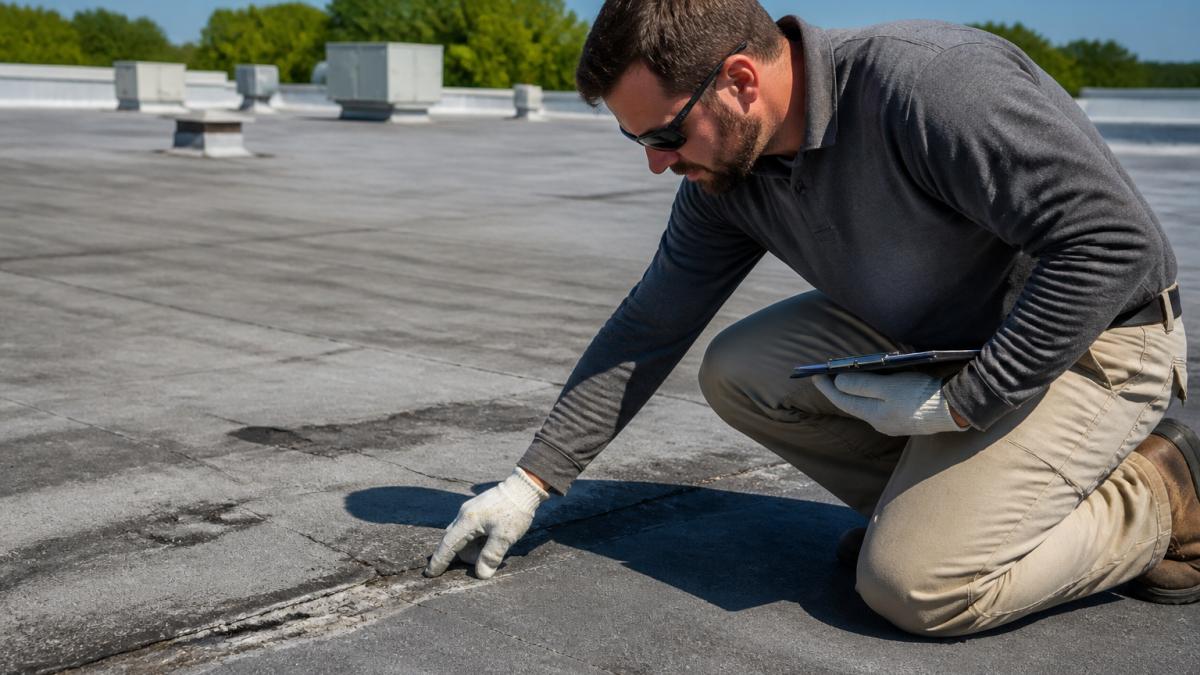
Seams join two membrane sections, flashing meets walls, curbs, or equipment, and penetrations are holes where pipes and ducts pass through. These areas fail more often than flat membrane because they experience more movement and stress.
Inspect every seam by running your hand along it. Feel for:
- Gaps or separations where the seal has failed
- Raised edges or curling that indicates movement
- Sealant that is cracked, dried out, or missing
Check flashing around the perimeter and around all roof penetrations. Flashing should be sealed tight to the membrane. Look for:
- Gaps between flashing and membrane
- Sealant that is cracked or deteriorated
- Rust or corrosion on metal flashing
Penetrations are high-risk areas. Check the seal around every pipe, duct, conduit, and equipment base. Verify that sealant is intact and that nothing is pulling away from the roof.
Commercial Roof Inspection Checklist by Material Type
Different roof materials have different failure modes. Knowing your roof type helps you spot problems specific to that system.
TPO and PVC membrane systems
TPO (thermoplastic polyolefin) and PVC (polyvinyl chloride) are heat-welded membranes. They fail at seams first because heat welds degrade over time.
Check for:
- Seam separation or peeling at the edges
- Membrane blistering or bubbling (indicates trapped moisture under the membrane)
- Punctures or tears in the white or gray membrane surface
TPO and PVC membranes are durable but vulnerable at seams. If you see seam separation, prioritize repair immediately, water will follow the seam underneath the membrane.
EPDM rubber roofs
EPDM (ethylene propylene diene monomer) is a rubber membrane glued or mechanically fastened to the roof deck. It fails through punctures, seam separation, and membrane deterioration.
Check for:
- Punctures or cuts in the black rubber surface
- Seams that are separating or lifting
- Areas where the membrane is not fully adhered to the deck
EPDM shrinks slightly over time, which can cause edge separation. Gaps between the membrane and the perimeter are normal aging but need sealing to prevent water entry.
Spray polyurethane foam and coated systems
Spray polyurethane foam (SPF) is sprayed onto the roof and then coated with a protective layer. It fails when the coating deteriorates or when the foam is punctured.
Check for:
- Coating cracks, peeling, or missing sections
- Exposed foam (yellow or tan color showing through)
- Soft spots or spongy areas in the foam
SPF roofs need recoating every 10-15 years. If the coating is cracked or missing in large areas, the foam underneath becomes vulnerable to UV damage and water intrusion; recoating extends roof life significantly.
Flat Roof Membrane Inspection: Identifying Common Defects
Blisters, cracks, and punctures
Press a blister gently. If it's soft and squishy, it contains water. If it's firm, it may contain air.
Cracks are splits in the membrane caused by movement, UV exposure, or material fatigue.
Punctures are holes caused by foot traffic, dropped tools, or debris. They leak immediately.
Any puncture larger than 1/8 inch should be repaired. Smaller holes may seal temporarily with sealant, but they will fail eventually.
Soft spots and delamination
Soft spots feel spongy or weak when you press down, indicating that the membrane has separated from the layer below or that water has saturated the insulation underneath.
Delamination is when the membrane layers separate from each other or from the deck. It's caused by moisture, improper installation, or material failure.
Walk your entire roof and press down periodically with your hand. If any area feels soft or different from the surrounding membrane, mark it.
Water intrusion and leak sources
Water intrusion is the most common cause of commercial roof failure. It starts at seams, penetrations, or low spots where water pools, then spreads through insulation and into the building.
Common leak sources:
- Seams that have separated or where sealant has failed
- Flashing around penetrations that is not sealed
- Low spots where water ponds and eventually saturates the membrane
If you see water stains on the interior ceiling, the leak source is directly above. Trace the stain upward to find the roof leak. Water doesn't always leak straight down, it can travel along beams or insulation before dripping inside.
Commercial Roof Drainage Inspection: Checking Gutters and Drains
Ponding water and drainage failures
Ponding water is water that remains on the roof after rain. It should drain within 48 hours. If water is still visible days after rain, your drainage system is failing.
Ponding is dangerous because:
- Standing water adds weight to the roof structure
- Water seeps through the membrane over time
- Algae and debris accumulate in the water, creating a wet, heavy mass
Walk your roof after rain (or simulate rain conditions by observing the roof after heavy rainfall). Note any areas where water collects. These are low spots that need attention.
Roof drain condition and debris
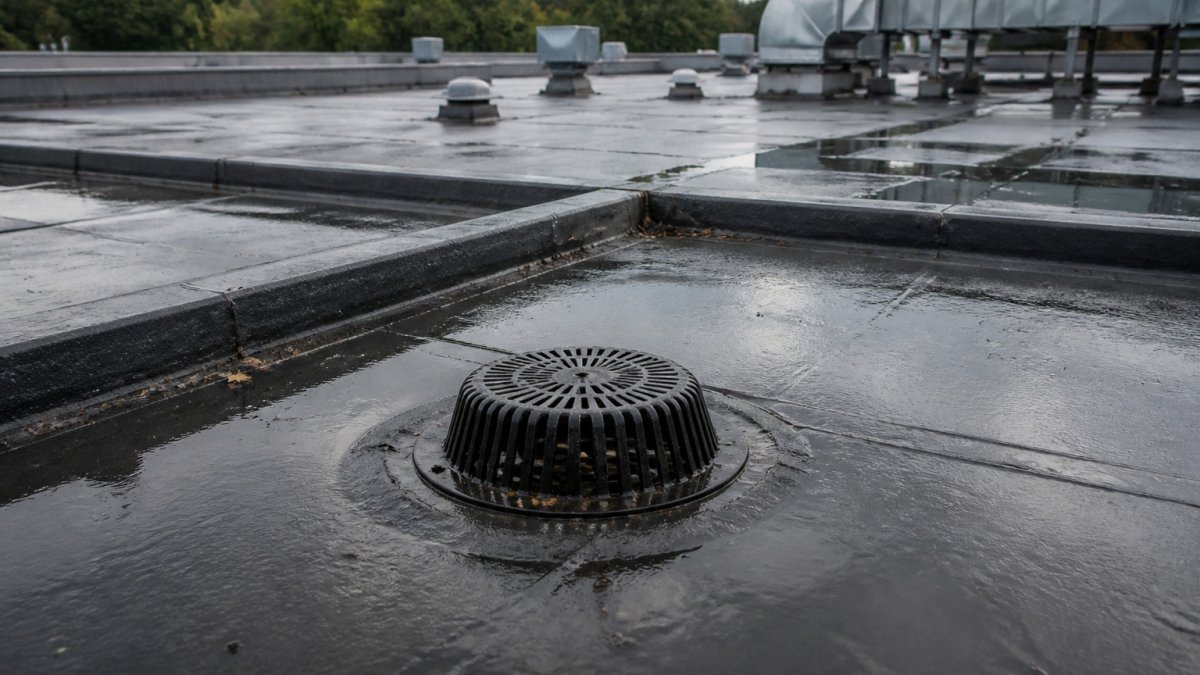
Commercial flat roofs use roof drains or gutters to remove water. Check every drain:
- Clear debris from drain screens (leaves, dirt, gravel)
- Verify that water flows freely through the drain opening
- Check that drain pipes are not blocked or kinked
Clogged drains are the #1 cause of ponding water. A drain blocked by leaves or debris will cause water to back up and pond on the roof. This puts stress on the membrane and accelerates failure.
Clean roof drains twice per year: once in spring after trees have shed pollen and seeds, and once in fall after leaves have fallen.
Creating Your Commercial Roof Inspection Report
Documentation and photographic evidence
Your inspection report is proof of the roof's condition, protecting you legally and supporting insurance claims. Document everything systematically.
Include in your report:
- Date and time of inspection
- Weather conditions at time of inspection
- Roof material type and approximate age
Photographs are critical. They provide visual proof of damage and help contractors understand what needs repair. Take photos from multiple angles. Include a reference object (ruler, coin, or your hand) to show scale.
Prioritizing repair recommendations by urgency
Not every defect needs immediate repair. Prioritize based on risk:
Immediate (repair within 1 week):
- Active leaks or water intrusion inside the building
- Punctures larger than 1/4 inch
- Seam separation that is actively leaking
Soon (repair within 1-3 months):
- Small punctures (1/8 to 1/4 inch)
- Seam separation that is not yet leaking but shows signs of failure
- Blisters that are large or increasing in size
Planned (repair within 6-12 months):
- Small cracks or surface deterioration
- Minor blistering
- Worn coating on SPF roofs
Monitoring (no repair needed yet, but track):
- Small hairline cracks
- Minor discoloration
- Slight membrane shrinkage on EPDM roofs
When you identify defects during inspection, assign each one a priority level. This helps you budget repairs and plan maintenance schedules. Immediate repairs prevent costly water damage. Soon repairs extend roof life. Planned repairs keep the roof in good condition long-term.
Regular inspections are the foundation of roof maintenance. They catch problems early, document your roof's condition, and help you plan repairs strategically.
If you're uncertain about what you're seeing or need professional-level documentation for insurance purposes, Leitch Roofing offers expert commercial roof inspections with detailed reporting and repair recommendations. Get a free estimate today and let us assess your roof's actual condition. Get a free estimate today and let us assess your roof's actual condition.
Frequently Asked Questions
How often should a commercial flat roof be inspected?
Most commercial flat roofs benefit from at least two formal inspections annually: one in spring to assess winter damage and one in fall to prepare for harsh weather. Buildings in areas with severe storms, hail, or extreme temperature swings may need quarterly inspections. After any significant weather event, schedule an inspection within 48 hours to document damage for insurance claims. The roof's age and material type also affect frequency; older systems or those nearing the end of their useful life warrant more frequent monitoring.
What should be included in a commercial roof inspection checklist?
A thorough commercial roof inspection checklist must cover the roof membrane (checking for blisters, cracks, punctures, and soft spots), all seams and sealing integrity, flashing around penetrations and edges, drainage systems and roof drains for blockages or ponding water, and interior signs of water intrusion. Document the condition of gutters, sealants, and any previous patches or repairs. Take photographs of problem areas and note the roof's overall condition, remaining useful life estimate, and any coatings or protective layers present. This checklist becomes the foundation of your commercial roof inspection report.
Can I inspect my commercial flat roof myself, or do I need a professional?
Building owners can perform basic visual inspections from ground level or safe roof edges to spot obvious damage, ponding water, or debris. However, a full roof-walk inspection carries fall risks and requires specialized knowledge to identify subtle defects like delamination, membrane separation, or early-stage water intrusion. Professional inspectors have safety equipment, measurement tools, and experience distinguishing routine wear from urgent repair needs. If you're planning major decisions (repair vs. replacement, insurance claims), a professional inspection provides the documentation and credibility insurers and contractors expect.
What are the most common signs of damage on a commercial flat roof?
Common defects include blisters and bubbles in the membrane (indicating moisture or delamination), visible cracks or punctures in the surface, soft or spongy spots when walked on, loose or separated seams, ponding water that doesn't drain within 48 hours, deteriorated or missing flashing around roof penetrations, and evidence of water intrusion inside the building. Storm damage may appear as hail dents, torn membrane sections, or displaced components. Discoloration, algae growth, or coating breakdown can signal accelerated aging. Early detection of these signs through regular inspection prevents water intrusion and extends the roof's remaining useful life.