 how-to
7 Steps to Choose a Reputable Roofing Contractor
Last Updated: October 30, 2026
Quick Summary
To choose a reputable roofing contractor, verify the license yourself on your state's licensing board website and confirm insurance directly with the carrier, not the contractor. Then compare every estimate line by line on scope, not just the bottom-line price.
- Gather four to six names from referrals, your insurance agent, and local building departments.
- Ask for the license number, legal business name, and expiration date, then look them up yourself.
- Call the insurance agent on the certificate to confirm the policy is active and covers roofing.
- Compare scope before price, since a lower bid may simply cover less work.
- Never pay the full amount upfront or sign a contract with blank sections.
Table of Contents
- Start With Local Research and Referrals
- Check Online Reviews, Ratings, and Reputation
- Verify the Roofing Contractor License and Insurance
- Assess Experience, Expertise, and Past Work
- Questions to Ask a Roofing Contractor Before You Sign
- How to Compare Roofing Estimates Line by Line
- Use a Roof Replacement Contract Checklist
- Request a Free Estimate From Leitch Roofing
- Frequently Asked Questions
Start With Local Research and Referrals
Learning how to choose a reputable roofing contractor starts with a short list of names worth your time. Build that list from people who have lived through a roof replacement: neighbors, coworkers, and your local building inspector.
Ask three questions about every name you collect:
- Did the crew show up when promised?
- Did the final bill match the written estimate?
- Would you hire them again?
A referral from someone who answers yes to all three beats any ad. To confirm whether a company covers your town before you call, check its website or ask the company directly.
Where to Find Candidates Worth Calling
Start with your own circle, and ask your insurance agent. Agents deal with roofing contractors after every storm and know who files clean claims and who creates headaches.
Then widen the search:
- Local hardware stores and lumber yards often keep a list of contractors who pay their bills.
- Your state's contractor licensing board may publish a searchable database.
- Neighborhood apps and community groups surface recent, firsthand feedback.
Gather four to six names. Any fewer and you lose use when comparing bids.
Check Online Reviews, Ratings, and Reputation
Online reviews are your fastest filter, but only if you read them correctly. You can also read verified customer reviews for the contractor you're considering. A reputable contractor shows a steady pattern of recent reviews across several years. Watch for these signals:
- Reviews that mention a specific crew, project manager, or job address
- Responses from the owner to negative reviews
- Complaints about the same problem repeated by different customers
One bad review means little. Five reviews describing the same missed deadline means a lot.
Check the Better Business Bureau rating as a secondary data point, not the deciding one. A high rating with no complaint history is a good sign. So is a contractor who resolves complaints publicly.
No reviews at all isn't automatically bad, but it means leaning harder on references.
Verify the Roofing Contractor License and Insurance
License and insurance checks are the step most homeowners skip, and the one that protects you most. The goal isn't paperwork, it's confirming, in writing and from the source, that the company is legally allowed to roof your home and financially able to pay for a mistake.
Verify the License Yourself
Ask for the license number, exact legal business name, and expiration date, then look it up on your state's contractor licensing board website. Don't accept a photo of a certificate, a laminated card, or a screenshot, those are easy to fake or reuse after expiration. On the lookup page, confirm four things:
- The license is active, not expired or suspended
- The legal name matches the name on your estimate and contract (not just a trade name or DBA)
- The license classification covers residential roofing work, not only commercial or specialty trades
Some states license roofing contractors at the state level; others delegate to county or municipal building departments. If your state board has no record, call your local building department and ask whether the company is registered to pull permits in your jurisdiction.
Confirm Insurance With the Carrier, Not the Contractor
Insurance comes in two parts, and you need proof of both:
- General liability insurance covers damage to your home or a neighbor's property during the job, a dropped bundle of shingles through a skylight, a ladder through a window, runoff staining a neighbor's siding.
- Workers' compensation covers injuries to crew members on your property. Without it, an injured worker can pursue your homeowner's policy for medical bills.
Ask for a certificate of insurance (COI) and read it line by line. A COI is issued by the insurance carrier or its agent, not typed up by the contractor. Confirm these fields:
| Field on the COI | What to Confirm |
|---|---|
| Named insured | Matches the contractor's legal name on the license and contract |
| General liability limits | At least the limits your state or lender requires; ask what the per-occurrence limit is |
| Workers' compensation | Shows an active policy, not an exemption for a one-person operation |
| Policy effective and expiration dates | The policy is active on your project dates, not just at bid time |
| Certificate holder | You or your lender can be listed as certificate holder so you receive cancellation notices |
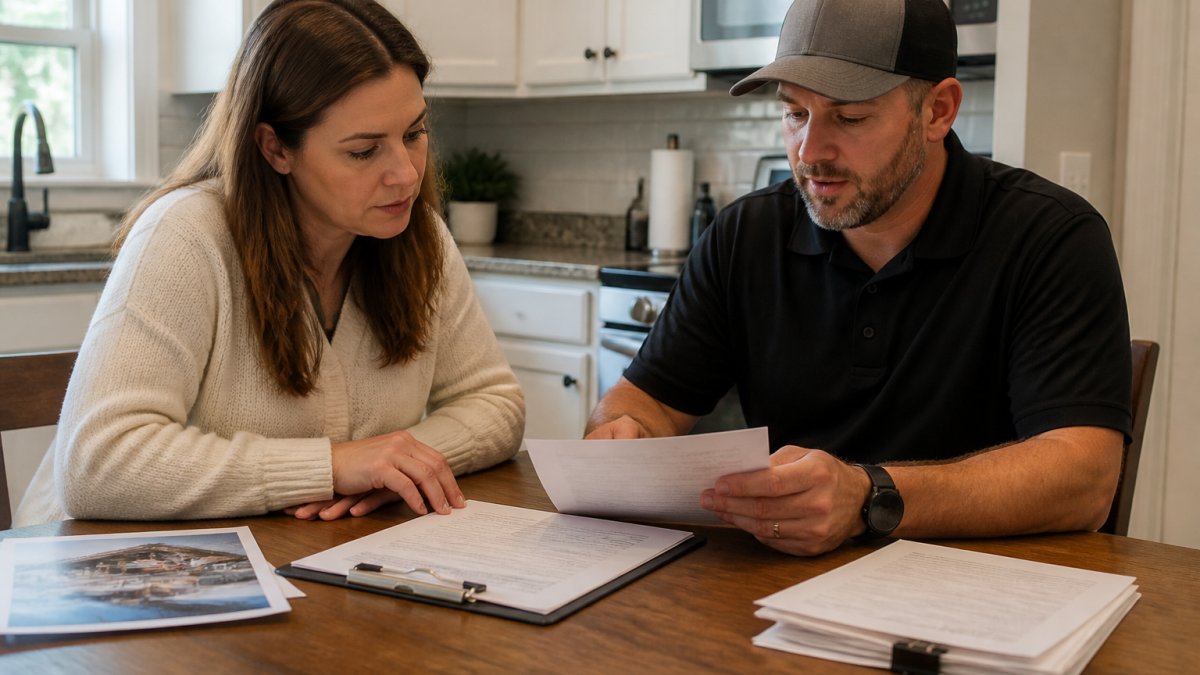
Then call the insurance agent listed on the certificate, not the contractor's office, and ask two questions: is the policy active today, and does it cover roofing work at your address? A certificate can be altered, and a policy can be canceled for nonpayment the week after it was issued.
What to Confirm About Subcontractors
Many roofing companies hire subcontractors for installation, tear-off, or specialty work like flashing and skylights.
Ask these questions before signing:
- Will your own employees do the work, or will you bring in a sub?
- If you use a subcontractor, will you give me their name and a certificate of insurance before they start?
- Does the subcontractor carry their own general liability and workers' comp, or are they covered under your policy?
Get the answers in writing in the contract. If a subcontractor causes damage and isn't insured, the claim can land on your homeowner's policy.
Watch out: If a contractor says they'll "get the paperwork to you later," stop. Uninsured crews on your roof can leave you liable for medical bills and property damage.
Assess Experience, Expertise, and Past Work
Experience means more than years in business. A roofing contractor with a decade of local work knows how local weather, building codes, and inspection schedules affect your project.
Ask for proof of similar projects. If your home has a steep pitch or complex roofline, ask to see jobs like yours.
Look at the details: clean flashing, straight lines, and tidy job sites tell you more than a brochure.
Questions to Ask a Roofing Contractor Before You Sign
The right questions reveal how a company operates. Ask them in person and note how the answers sound. Vague answers are a warning.
- How long have you worked in this area? Local experience signals familiarity with codes and weather.
- What's your process if it rains mid-project? A good crew has a plan to protect your home.
- Who is my point of contact? You want one named project manager, not a call center.
- What does your workmanship warranty cover? Get the length and terms in writing.
- Do you handle insurance claims? Claims work takes experience with adjusters and documentation.
- How do you handle change orders? You want written approval before any extra work.
- What's the payment schedule? A large upfront deposit is a red flag.
If you want to see the full scope of what a residential contractor should offer, compare each bidder's promises against the scope outlined in the estimate.
How to Compare Roofing Estimates Line by Line
Comparing estimates by the bottom-line number is the most common mistake homeowners make. Two bids that differ by thousands may not describe the same job, one may include tear-off and decking replacement, the other may not. The only fair comparison is scope against scope.
Put Every Bid in the Same Format
Before you compare prices, ask each contractor to break the estimate into the same categories. A bid that lumps everything into "roof replacement, $X" cannot be compared to a bid with ten line items. Request these lines from every bidder:
| Estimate Line | What to Check | Why It Matters |
|---|---|---|
| Roof area and pitch | Same square footage and slope | Different measurements mean different scope |
| Tear-off and disposal | Old shingles removed, dumpster included | Some bids exclude disposal or charge per load |
| Underlayment and decking | Type and replacement allowance | Hidden deck rot changes the price |
| Ventilation | Ridge and intake vents specified | Poor ventilation shortens roof life |
| Flashing and trim | Replaced or reused | Reused flashing leaks |
| Warranty terms | Material and workmanship split | One "warranty" can mean two things |
| Payment schedule | Deposit and milestone payments | Large upfront deposits carry risk |
A Worked Comparison: Two Bids, Same Roof
Suppose two bids arrive for the same 2,000-square-foot asphalt shingle roof. Bid A is $14,500; Bid B is $11,800. On the surface, Bid B looks like the better deal. Read the line items and the picture changes:
- Bid A includes tear-off and disposal, replaces up to two sheets of decking at no extra charge, specifies a synthetic underlayment, includes new ridge and intake ventilation, and replaces all flashing. Workmanship warranty is 10 years.
- Bid B lists tear-off as "included" but disposal as a separate $600 charge, allows $0 for decking replacement (billed at time and materials if rot is found), reuses existing flashing, and specifies a 5-year workmanship warranty.
Once you add the disposal charge and a realistic decking allowance, Bid B's true cost climbs toward Bid A's, and it still carries a shorter warranty and reuses flashing. The lower number was a smaller scope, not a better price.
Read the Exclusions and Allowances
Exclusions are the lines that tell you what the contractor will not do, and they are where budgets break. Look for these phrases and ask what they mean in dollars:
- "Decking replaced at additional cost", ask for a per-sheet price and a realistic allowance for your roof's age.
- "Disposal not included", ask who pays for the dumpster and dump fees.
- "Flashing to be reused where possible", reused flashing is a common leak source; ask for replacement pricing.
An allowance is a placeholder dollar amount for work the contractor can't see until tear-off. A $0 decking allowance is not a promise of no rot; it's a promise to bill you later. Ask each bidder for their per-sheet decking price and compare those numbers.
Compare Warranties on the Same Terms
A "25-year warranty" can mean the material warranty, the workmanship warranty, or both, and they are not the same. Ask each bidder to state separately:
- The material warranty length and what it covers (manufacturer defects vs. labor)
- The workmanship warranty length and whether it is prorated
- Whether the warranty transfers to a new owner if you sell
A longer material warranty from a manufacturer is worth little if the workmanship warranty is one year. Compare both numbers side by side.
Ask Each Contractor to Walk You Through Their Bid
Ask each contractor to explain any line you don't understand, and take notes. A reputable contractor will walk you through the scope without pressure and put clarifications in writing. If a bidder can't explain their own line items, that's your answer about how the project will go.
Once scopes are normalized, the price comparison becomes meaningful, and you can choose on value rather than the lowest number.
Use a Roof Replacement Contract Checklist
A written contract protects you when something goes wrong, and something always can. Before you sign, confirm the contract includes every item below:
- Contractor's legal name, license number, and address
- Full scope of work, in plain language
- Roofing materials listed by brand and product line
Never sign a contract with blank sections. Never pay the full amount upfront. And never accept a deal that requires you to sign before you've had time to read it.
Permits, Inspections, and Red Flags
Most roof replacements require a permit, and the contractor should pull it. Ask who files the permit and who meets the inspector. If a contractor suggests skipping the permit to save time, walk away. Unpermitted work can complicate a future home sale and may void your insurance coverage.
Watch for these red flags:
- Door-to-door sales pressure right after a storm
- Demands for a large cash deposit
- No local address or a PO box only
Request a Free Estimate From Leitch Roofing
Choosing a reputable roofing contractor comes down to verification, not sales pitches. Check the license, confirm the insurance, read the reviews, and compare every estimate line by line.
Leitch Roofing provides residential and commercial roofing services, and we offer insurance claim assistance. Every project starts with a free estimate.
Get started with Leitch Roofing and request a free estimate for your roof today.
Frequently Asked Questions
How do I pick a roofer I can actually trust?
Start by confirming the company holds a valid state license and carries both liability insurance and workers' compensation coverage. Ask for proof, not just a verbal yes. Then read recent online reviews, request references from similar projects, and get two or three written estimates you can compare line by line. A reputable roofing contractor will answer every question without pressure and put the full scope of work in writing before asking for a deposit.
What questions should I ask a roofing contractor before hiring?
Ask how long the company has worked in your area, whether crews are employees or subcontractors, and who manages your project day to day. Request the license number and certificate of insurance, and confirm the manufacturer and workmanship warranty terms in writing. Also ask whether the contractor will pull the permit and schedule inspections, and what the payment schedule looks like. Clear answers to all of these separate a reliable contractor from a risky one.
What should a roofing estimate include so I can compare quotes fairly?
A complete estimate lists roofing materials by type and quantity, tear-off and disposal of the old roof, underlayment, flashing, ventilation, labor, permits, and cleanup. It should state the project scope in plain terms and note what is excluded. When you compare roofing estimates, line up each item side by side. A quote that is thousands of dollars cheaper often leaves out decking repair, ventilation, or disposal, which then show up as change orders later.
What are red flags when hiring a roofer?
Watch for door-to-door pressure to sign the same day, demands for a large cash deposit up front, no physical business address, and offers to waive your insurance deductible, which is illegal in most states. Be wary of anyone who cannot show a license or insurance certificate, refuses to put the scope in writing, or asks you to sign a contract before an inspection. High-pressure sales tactics and vague paperwork are the two clearest warning signs of a roofing contractor to avoid.