 how-to
Commercial Roof Insulation for Energy Efficiency
Table of Contents
- How Commercial Roof Insulation Reduces Heat Transfer
- Commercial Roof Insulation Types and Their Performance
- Understanding R-Value and Climate Zone Requirements
- Energy Savings and Operating Cost Reduction
- Assessing Your Roof and Planning Installation
- Commercial Roof Insulation Cost and Payback Timeline
- Moisture Control and Long-Term Roof Performance
- Conclusion
- Frequently Asked Questions
Last Updated: October 11, 2026
How Commercial Roof Insulation Reduces Heat Transfer
Commercial roof insulation works by creating a thermal barrier between your building's interior and the outside environment. Heat naturally flows from warm areas to cold ones. Insulation slows that flow by trapping air pockets that resist temperature movement.
Quality commercial roof insulation interrupts heat transfer through conduction, convection, and radiation, reducing HVAC workload by preventing heat gain in summer and loss in winter.
Your roof is one of the largest unprotected surfaces on commercial buildings. Uninsulated dark roofs reach 150°F+ in summer, forcing cooling systems to work overtime. In winter, warm interior air escapes through uninsulated roofs. Commercial roof insulation stops both scenarios.
The result is lower heating and cooling demand. Your HVAC system doesn't have to run as hard or as long. That's where real energy savings begin.
Commercial Roof Insulation Types and Their Performance
Different insulation materials perform differently. The best choice depends on your building's needs, climate, and budget.
Fiberglass Batts and Blankets
Fiberglass is the most common and affordable commercial roof insulation type. It traps air to resist heat transfer, is lightweight, and installs easily. Its main limitation is moisture sensitivity, wet fiberglass loses thermal resistance significantly.
Rigid Foam Boards
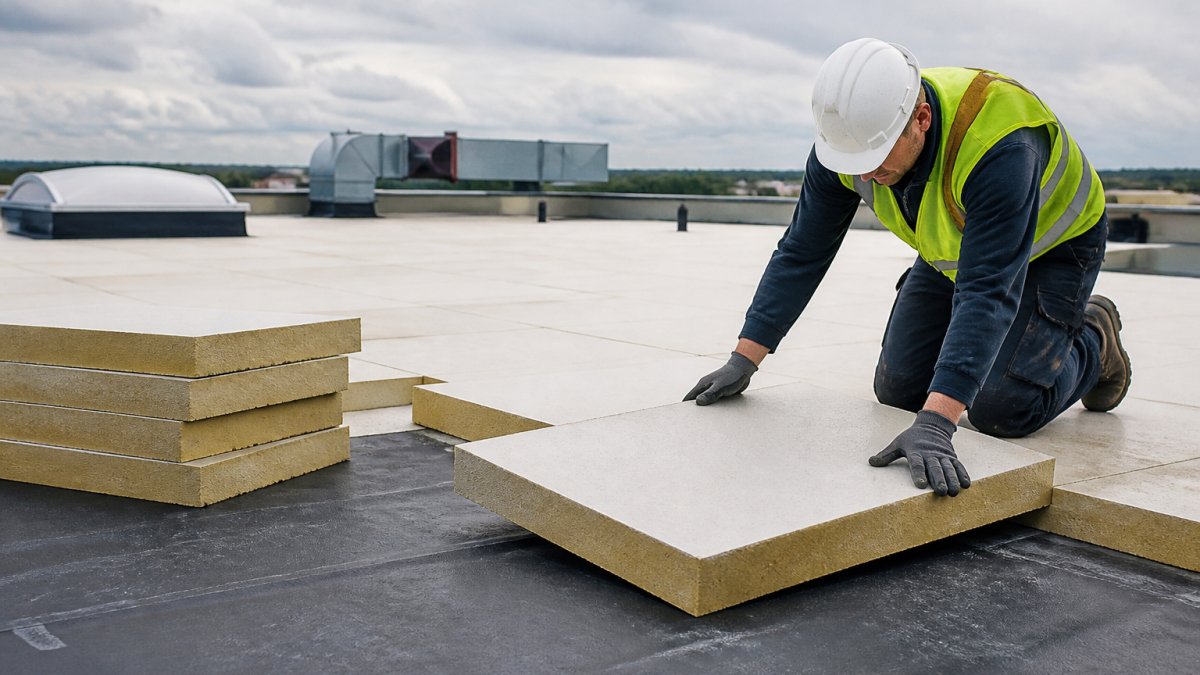
Rigid foam (polyurethane, polystyrene, or polyisocyanurate) offers higher R-value per inch than fiberglass in a thinner package and is moisture-resistant, making it ideal for flat roofs. Though more expensive, it lasts longer and provides structural support.
Spray Foam Insulation
Spray foam expands to fill gaps and creates an air-tight seal that reduces thermal bridging. It has the highest R-value per inch and works well for irregular roofs, but costs more and requires certified installers.
Mineral Wool
Mineral wool is fire-resistant, handles moisture well, and provides acoustic benefits. It costs more than fiberglass but less than spray foam, making it a middle-ground option for buildings prioritizing fire safety.
Understanding R-Value and Climate Zone Requirements
R-value measures thermal resistance. Higher R-values mean better insulation. The number tells you how well a material resists heat flow. An R-30 insulation resists heat flow twice as effectively as R-15.
Required R-values depend on climate zone. Check your local building code or building department for your roof assembly's minimum requirement. Many commercial buildings exceed the minimum to accelerate long-term energy savings.
Energy Savings and Operating Cost Reduction
Commercial roof insulation reduces heating and cooling costs by lowering thermal load on your HVAC system. Understanding how to estimate and measure savings is critical to justifying the investment.
How Roof Insulation Reduces HVAC Demand
Uninsulated dark roofs reach 150-180°F in summer, forcing cooling systems to work harder. In winter, warm air escapes through uninsulated roofs. Proper roof insulation reduces thermal load by 20-40%, lowering HVAC runtime and energy consumption.
Estimating Annual Energy Savings
To estimate savings, gather: (1) annual heating and cooling costs from utility bills, (2) HVAC's percentage of total energy use (typically 40-50% for commercial buildings), and (3) expected reduction from roof insulation (10-25% depending on climate and current R-value).
Example Calculation:
Assume a 50,000-square-foot office building in a temperate climate (Zone 4) with:
- Annual utility costs: $120,000
- HVAC percentage of total energy: 45%
- Current annual HVAC cost: $54,000
- Expected reduction from roof insulation retrofit: 15%
- Annual energy savings: $54,000 × 0.15 = $8,100 per year
If the retrofit costs $75,000 (materials and labor), the payback period is $75,000 ÷ $8,100 = 9.3 years. After payback, $8,100 annually goes directly to your bottom line.
In a colder climate (Zone 6) where heating is a larger load, the same retrofit might reduce HVAC energy by 20%, yielding $10,800 in annual savings and a payback period of 6.9 years.
Professional energy modeling provides accurate savings estimates for larger buildings. It accounts for building geometry, climate, HVAC efficiency, occupancy, and proposed insulation to predict annual energy consumption before and after retrofit.
Measure actual savings by comparing utility bills before and after, accounting for weather variations and occupancy changes. Compare the same months year-over-year to control for seasonal variation. For precision, use a building energy management system (BEMS) to monitor HVAC consumption directly.
Beyond energy savings, roof insulation improves occupant comfort, extends HVAC system life, reduces peak demand charges, lowers carbon emissions, and may qualify for utility rebates or tax credits. Check with your local utility and DSIRE for available programs.
Payback periods typically range from 3 to 10 years, depending on climate zone, current insulation level, energy rates, material choice, and building size. Most commercial buildings see payback within 5-7 years, after which savings continue indefinitely.
Assessing Your Roof and Planning Installation
A proper assessment of existing conditions prevents costly mistakes and ensures your retrofit delivers expected savings.
Visual and Physical Inspection
Start by accessing your roof deck or attic space if possible. Look for:
- Visible insulation material: Fiberglass batts, rigid foam boards, spray foam, or mineral wool. Note the color, condition, and approximate thickness.
- Moisture damage: Wet spots, discoloration, mold growth, or soft areas indicate past or ongoing water intrusion. These are red flags that must be addressed before new insulation is installed.
- Gaps or missing sections: Insulation that's been removed, compressed, or never installed in the first place. Pay special attention to areas around roof penetrations, HVAC units, and skylights.
- Vapor barrier condition: Look for tears, separation, or deterioration in any membrane layer. A compromised vapor barrier allows moisture to migrate into the insulation.
- Thermal bridging evidence: Visible fasteners, metal framing, or structural beams that conduct heat directly through the insulation layer.
Measuring and Calculating Current R-Value
Measure insulation thickness and multiply by the material's R-value per inch (fiberglass R-3.2-3.8, rigid foam R-3.6-6.5, spray foam R-5.5-6.5, mineral wool R-3.0-3.5). Compare to your local building code requirement to determine retrofit necessity.
Determining Code Requirements by Climate Zone
The IECC and ASHRAE 90.1 specify minimum R-values by climate zone: hot climates R-13-19, temperate R-19-25, cold R-25-30, very cold R-30-38. Contact your local building department for your exact requirement. Many owners exceed minimums to accelerate payback.
Assess roof assembly compatibility: Is the existing membrane in good condition? What is the deck material (steel, concrete, wood)? Are there penetrations (HVAC, skylights, vents)? Does the structure support additional weight? Spray foam handles irregular penetrations better than rigid boards.
When to Involve a Professional
If your building is older, has a complex roof assembly, or shows signs of moisture problems, hire a professional roofing contractor or energy auditor to conduct a detailed assessment. They can:
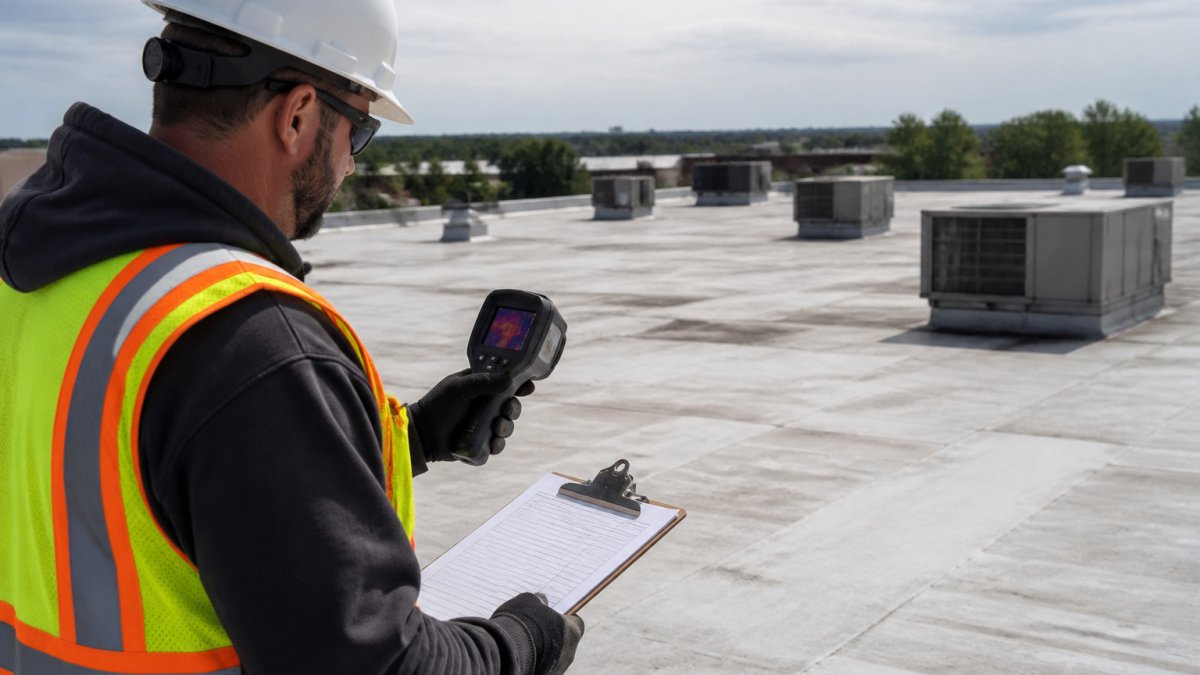
- Use thermal imaging to identify heat loss patterns and moisture pockets
- Perform core samples to determine exact insulation type and thickness
- Assess vapor barrier integrity and moisture risk
- Model energy savings based on your specific building and climate
- Recommend the optimal retrofit strategy and material combination
A professional assessment costs $500-$2,000 depending on building size and complexity, but it prevents costly mistakes and ensures your retrofit meets code and performs as expected.
Planning the Retrofit Scope
Once you understand your current condition and code requirements, decide on your retrofit approach:
- Full replacement: Remove existing insulation and roof membrane, install new insulation and membrane. Most expensive but allows you to address any underlying moisture or structural issues.
- Overlay: Install new insulation directly over the existing roof. Faster and less disruptive but may not address existing problems. Only viable if the existing roof is in good condition and can support the additional weight.
- Partial upgrade: Insulate only the worst-performing areas or those with the highest heat loss. Lower cost but less comprehensive savings.
- Phased approach: Retrofit one section of the roof at a time to spread costs and minimize operational disruption.
Consider your building's occupancy and operations. A retrofit that requires roof access or interior work may need to be scheduled during off-hours or slower business periods to avoid disrupting tenants or customers.
Commercial Roof Insulation Cost and Payback Timeline
Installation cost depends on material type, R-value, roof size, and local labor rates. Fiberglass is the least expensive option. Spray foam is the most expensive. Rigid foam falls in the middle.
Rather than guess at pricing, get quotes from local contractors. Leitch Roofing provides free estimates that break down material and labor costs.
The payback period, how long it takes for energy savings to cover the installation cost, typically ranges from 3 to 8 years for commercial roof insulation. After that, every dollar saved on utilities is pure benefit.
Calculate your potential payback by estimating current annual heating and cooling costs. Subtract the percentage you expect to save with new insulation. Divide the installation cost by that annual savings. The result is your payback period in years.
Example: If installation costs $50,000 and you save $8,000 per year on utilities, your payback is about 6 years. After that, $8,000 annually goes directly to your bottom line.
Many commercial property owners find this math compelling. The improvement pays for itself while improving comfort and reducing environmental impact.
Moisture Control and Long-Term Roof Performance
Moisture is the enemy of any roof assembly. Water trapped in insulation causes decay, mold growth, and loss of thermal performance. Proper moisture control is essential for commercial roof insulation to last.
Your roof assembly needs a vapor barrier, a layer that stops moisture from moving through the insulation. Without one, warm interior air can condense inside the insulation as it hits cold outdoor air. That condensation reduces R-value and damages materials.
The placement of the vapor barrier matters. In cold climates, it goes on the warm side (interior). In hot climates, it goes on the cool side (exterior). In mixed climates, you may need a smart vapor retarder that adapts to seasonal changes.
Proper ventilation also helps manage moisture. Some roof designs include ventilation channels that allow moisture to escape. Others use breathable membranes that let water vapor pass while blocking liquid water.
Installation quality directly affects long-term performance. Gaps, compression, or incorrect vapor barrier placement all reduce effectiveness. This is why hiring experienced commercial roof insulation contractors matters. Poor installation can turn a good material into a poor performer.
Inspect your roof periodically. Look for signs of moisture problems:
- Soft spots or sagging areas
- Visible mold or mildew
- Peeling paint or damaged finishes
- Unusual odors in upper floors
Catching moisture problems early prevents costly damage to the entire roof assembly.
Conclusion
Commercial roof insulation is one of the highest-impact energy efficiency upgrades you can make. It reduces heat transfer, lowers HVAC demand, cuts utility costs, and improves occupant comfort. The payback period is typically 3-8 years, after which savings continue indefinitely.
The key is choosing the right material for your climate and ensuring proper installation. At Leitch Roofing, we've helped commercial property owners improve their buildings with professional commercial roof insulation solutions. Get a free estimate today and start saving on energy costs while improving your building's performance and sustainability.
Frequently Asked Questions
How much can commercial roof insulation reduce energy use?
Roof insulation typically reduces heating and cooling demand by 15-25%, depending on current insulation levels, building envelope condition, and climate zone. The actual energy use reduction depends on your HVAC system efficiency, occupancy patterns, and how much of your heat loss or gain occurs through the roof. Properly insulated commercial roofs lower the thermal load on HVAC systems, allowing them to operate more efficiently and reducing overall energy consumption and utility bills.
What R-value do I need for commercial roof insulation?
R-value requirements vary by climate zone and local building codes. Most commercial buildings in temperate zones require R-19 to R-30 in the roof assembly. Cold climates may require R-30 to R-49 or higher. Your building code, ASHRAE standards, and energy code compliance determine the minimum R-value. A roofing professional can assess your current insulation, climate zone, and code requirements to recommend the right R-value for your property.
Which commercial roof insulation material is best?
Common commercial roof insulation materials include fiberglass, mineral wool, foam board (polyiso, XPS, EPS), and spray foam. Each has different thermal performance, moisture resistance, fire ratings, and cost. Foam board offers high R-value per inch and moisture resistance; fiberglass and mineral wool are cost-effective but require vapor barriers; spray foam provides excellent air sealing but higher cost. The best choice depends on your roof assembly, climate, moisture risk, and budget. A qualified contractor can recommend the right material for your specific building.
How do I know if my commercial roof needs more insulation?
Signs your roof needs more insulation include high heating and cooling costs, uneven indoor temperatures, visible condensation on the roof deck, thermal imaging showing heat loss, or existing insulation that is compressed, wet, or below current code requirements. A professional roof assessment includes thermal imaging, moisture testing, and R-value measurement to determine if additional insulation will improve energy efficiency and building performance.