 how-to
7 Steps to Read a Roof Inspection Report
Last Updated: October 27, 2026
Quick Summary
To read a roof inspection report, start with the summary and priority findings, then check the inspection date, scope, and roof details. Sort each item as Now, Soon, or Monitor based on whether it involves active water entry, a safety risk, or an isolated defect.
- Read the summary and priority findings before the detailed pages.
- Check the inspection date and scope to see what the inspector could actually reach.
- Sort every finding into Now, Soon, or Monitor based on urgency and consequence.
- Treat any finding with active water entry or a safety hazard as a Now item.
- Put a recheck date on every Monitor item and ask the inspector to define unclear labels.
Table of Contents
- What a Residential Roof Inspection Report Covers
- Start With the Report Summary and Priority Findings
- Decoding Roof Design, Materials and Condition Ratings
- A Plain-Language Glossary of Report Terms and Severity Labels
- Prioritizing Findings by Urgency, Cost and Consequence
- Roof Inspection Report Examples: An Annotated Walkthrough
- Roof Inspection Report Checklist and Repair vs. Replacement Signs
- Questions to Ask a Roofing Contractor About Your Report
- Frequently Asked Questions
Most homeowners get a roof inspection report and have no idea what it says. The pages are full of codes, ratings and photos, and the one line that matters is often buried on page six. You don't need a roofing background to read one well. Once you know where to look, a roof inspection report tells you what is wrong, how urgent it is, and what to do next.
What a Residential Roof Inspection Report Covers
A roof inspection report is a written record of a visual review of your roof, usually done by a home inspector or roofing specialist. It describes the roof's design, materials, and the condition of each part the inspector could reach safely.
Most reports include:
- Roof design and material overview: the type of roof, shingle or other covering, and approximate roof age
- Visible damage and deficiencies: missing, cracked, or lifted shingles, and other problems noted
- Flashing and roof transitions: metal pieces around chimneys, vents, valleys, and walls
- Drainage and water-management parts: gutters, downspouts, and how water leaves the roof
- Safety concerns: anything that needs prompt attention
- Photos and measurements: visual proof of each finding
Every report also has a scope section listing what the inspector could and could not see. Read it first: a report that says "roof surface viewed from ground level" is far less complete than one based on a walk on the roof.
Start With the Report Summary and Priority Findings
Most reports open with a summary page that tells you the bottom line.
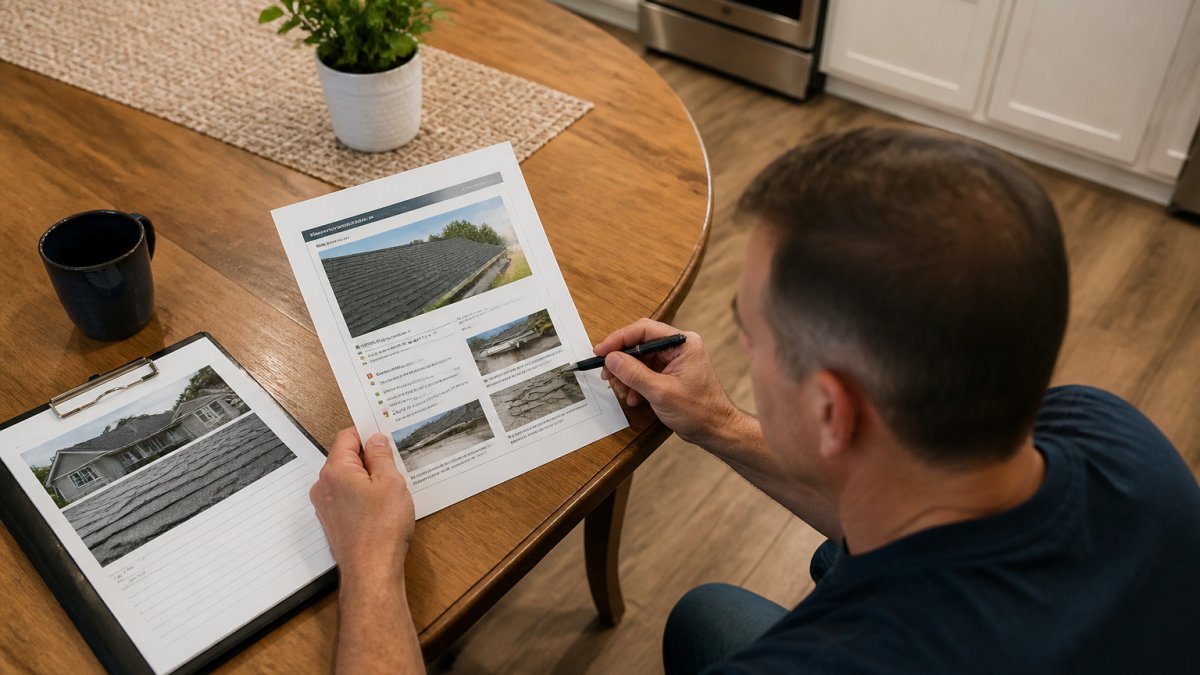
Look for a short list of priority findings. These are the items the inspector considers most important, often marked as urgent, high, or immediate. Read each one and ask yourself two questions:
- Is this a safety issue or a water-entry risk?
- Does it need action now, or can it wait for routine maintenance?
Skipping the summary and reading front to back is a common mistake. The detailed pages are useful, but the summary tells you where to start. Note the inspection date too: a report from several years ago may not reflect the roof you have today.
Decoding Roof Design, Materials and Condition Ratings
The middle section often uses terms that sound technical but are simple once you know them.
Roof design: Shape and slope affect how water runs off and how long materials last. A low-slope section may hold water longer than a steep one. The report should note the slope and the number of planes or sections.
Roofing material: The report should name the material and describe its condition, such as granule loss, curling, cracking, or brittleness.
Condition ratings: Many inspectors use a scale such as good, fair, poor, or a numeric score, and some estimate remaining service life.
Here's a simple way to organize what you find:
| Report Item | What It Tells You | What to Do |
|---|---|---|
| Good condition | No action needed now | Keep up routine checks |
| Fair condition | Wear is starting | Plan for repairs or monitoring |
| Poor condition | Failure risk is higher | Get a repair estimate soon |
| Remaining service life | Rough time left on the roof | Use it for budgeting |
A Plain-Language Glossary of Report Terms and Severity Labels
Inspection reports use specialized words, and the same word can mean different things on different reports.
The four buckets
- Observation: A neutral note about what the inspector saw. "Roof covering is asphalt shingles, approximately 15 years old." An observation is not a problem by itself; it is context.
- Deficiency: A condition the inspector considers a defect or departure from expected performance. "Two shingles are cracked near the south valley." A deficiency is a finding, not yet an instruction.
- Recommendation: A suggested action. "Recommend evaluation and repair of the valley shingles by a qualified roofing contractor." Recommendations tell you what to do about a deficiency.
- Hazard or urgent item: A condition with immediate safety or water-entry consequences. "Deteriorated flashing at the rear chimney with active staining below." These are the lines to act on first.
A single finding often produces all four: the observation (shingles present), the deficiency (two cracked), the recommendation (repair by a contractor), and sometimes a hazard flag (active leak). Label each line in the margin with O, D, R, or H, the pattern tells you where the real weight sits.
Common report terms
- Flashing: Metal strips that seal joints where the roof meets chimneys, vents, or walls.
- Penetration: Any pipe, vent, or chimney that goes through the roof.
- Granule loss: Shingle surface grit washing away, which speeds up aging.
- Curling or cupping: Shingle edges bending up or down.
- Ponding: Water sitting on a flat or low area instead of draining.
- Deficiency: A defect or problem the inspector found.
- Monitor: Not urgent now, but check it again at the next inspection.
- Maintenance: Routine upkeep such as cleaning gutters or sealing small gaps.
- Remaining service life: The inspector's estimate of how many years the covering may last, not a guarantee.
Why severity labels vary
There is no industry-wide severity scale. One inspector's "fair" may be another's "poor," and a 3 out of 5 can mean different things on two reports.
When a label is unclear, ask the inspector to define it in plain words and give one example of what would move an item from one label to the next.
A quick translation exercise
Take a line like "Flashing at rear chimney deteriorated; recommend evaluation by roofing contractor; monitor ceiling stain." Label it: deficiency (deteriorated flashing), recommendation (evaluation by contractor), and a monitor item (ceiling stain).
Prioritizing Findings by Urgency, Cost and Consequence
Not every item deserves the same attention, and the report rarely tells you the order to act in.
The three factors
- Urgency: Is there active water entry, a sagging area, or a safety hazard? Those come first.
- Consequence: What happens if you wait? A cracked shingle may let water into the decking; a small gutter gap may only cause minor staining. Ask what the most likely damage would be, not the worst possible.
- Cost of delay: Some repairs grow more expensive the longer they wait. Flashing failures often cause interior water damage, which costs far more to fix than the flashing itself.
Decision rules that make the sort consistent
- Any finding with active water entry or a safety hazard goes to "Now," regardless of cost. A ceiling stain under deteriorated flashing is the classic example: the stain is evidence water is already getting in.
- Any finding the inspector flagged as urgent or immediate goes to "Now" unless you have a specific reason to disagree, and if you disagree, get a second opinion in writing.
- Findings that are cosmetic or isolated go to "Monitor" with a recheck date. Granule loss across an aging roof is a monitor item; a single cracked shingle near a valley is usually a "Soon" repair.
- Anything that could become a safety issue if it worsens goes to "Soon," not "Monitor." Loose flashing over a walkway is an example.
- When two items compete for the same budget, fix the one that protects the building envelope first. Water management beats appearance every time.
A practical method: make three columns labeled "Now," "Soon," and "Monitor." Place each finding in the column that fits its urgency and consequence, and write a recheck date next to every "Monitor" item.
A worked example
Imagine a report with four findings: deteriorated chimney flashing with a ceiling stain below, two cracked shingles near a valley, a loose downspout, and moderate granule loss. Apply the rules:
- Chimney flashing with a stain → Now (active water entry).
- Cracked shingles near a valley → Soon (isolated deficiency, water-entry risk if it spreads).
- Loose downspout → Soon or Monitor depending on whether water is draining away from the foundation.
- Granule loss → Monitor with a recheck at the next inspection.
Each item gets one action, and the priorities are defensible if a contractor or insurer asks why you chose them.
What the report cannot establish
A visual inspection report describes what the inspector could see.
Verify before you authorize work
Before you approve repairs, match each proposed line item to a documented finding. Ask the contractor to point to the report line and photo supporting each recommendation.
Roof Inspection Report Examples: An Annotated Walkthrough
Imagine a report for a 15-year-old asphalt shingle roof on a home in Parsons.
The summary lists one priority finding: "Flashing at rear chimney deteriorated, possible water entry." The inspection section describes shingles with moderate granule loss and two cracked shingles near a valley. The drainage section notes a loose downspout. The photos show rust along the chimney flashing and a dark stain on the ceiling below.
Read this report by linking the findings. The chimney flashing is most serious, since the ceiling stain suggests water is already entering. The cracked shingles are a "soon" repair, the loose downspout is simple maintenance, and the granule loss is a "monitor" item signaling the roof is aging.
Each item gets one action, and the priorities are clear.
Roof Inspection Report Checklist and Repair vs. Replacement Signs
Use this checklist as you read any report:
- Did I read the summary and priority findings first?
- Did I check the inspection date and scope?
- Did I note the roof material, slope, and approximate age?
- Did I sort each finding into Now, Soon, or Monitor?
- Did I look at the photos for each priority item?
- Did I ask what any unclear label means?
Next, weigh repair against replacement. Repair is often better when damage is limited to a few areas, the roof has reasonable life left, and the deck is sound. Replacement becomes more likely with widespread granule loss, curling across many areas, repeated leaks, soft or damaged decking, or a roof age near the end of its expected service life.
Questions to Ask a Roofing Contractor About Your Report
Once you understand your report, bring specific questions to a roofing contractor:
- Which findings do you consider urgent, and why?
- Can you show me the exact area in the photos and on the roof?
- Is this a repair or a replacement, and what leads you to that conclusion?
- What would happen if we waited on this item for one year?
- Will the repair include the flashing and the surrounding shingles, or only the visible damage?
- How do your proposed repairs compare with the inspector's recommendations?
If you'd like help with your roofing needs, request a free estimate from Leitch Roofing.
Frequently Asked Questions
What should I look for in a residential roof inspection report?
Start with the summary, then check the roof covering condition, flashing and penetrations, drainage components, ventilation notes, and any safety or urgent items flagged by the inspector. Confirm whether the report states which areas were accessible and which were not. Look for photos tied to each finding and for clear repair recommendations rather than vague wording. Note any remaining service life estimate, and write down questions about anything marked as urgent before you contact a contractor.
How do I tell whether a roof inspection finding is urgent?
Ask the inspector to explain the consequence of waiting, not just the defect itself.
Should a roof inspection report include photos?
Ask the inspector to provide photos if you want to see the conditions described in the written text.
How can I tell whether a roof inspection report recommends repair or replacement?
Look for explicit language in the recommendations section, such as monitor, repair, or replace, along with the remaining service life estimate and the number of defects. A report that does not state a clear recommendation should prompt a follow-up question to the inspector.